Breath Training Pool — Report
Interview with Kumiko Ueda

In May 2025, at Hibiya Art Park 2025 in Tokyo’s Hibiya Park, the second edition of the participatory performance Breath Training Pool was presented under the title Imperial Moat Edition.
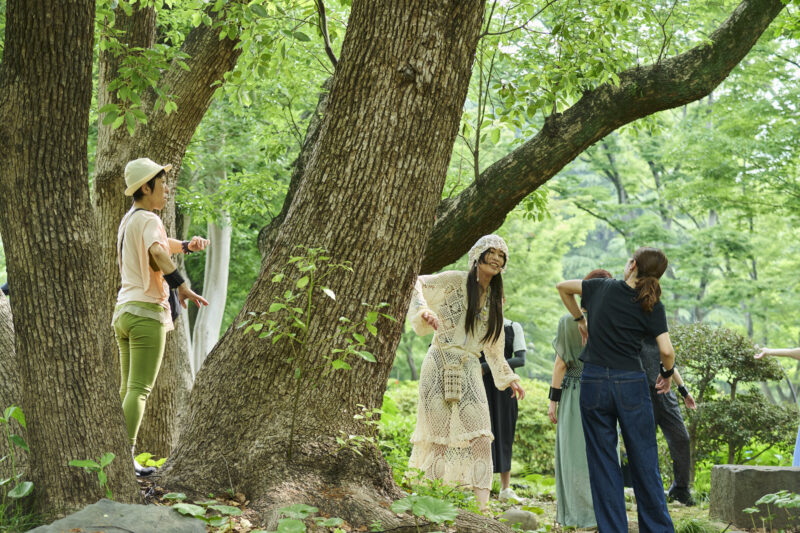
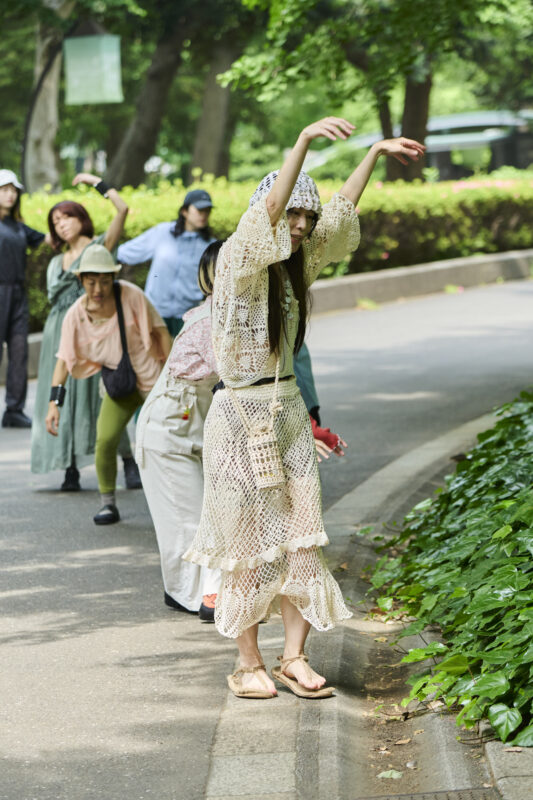
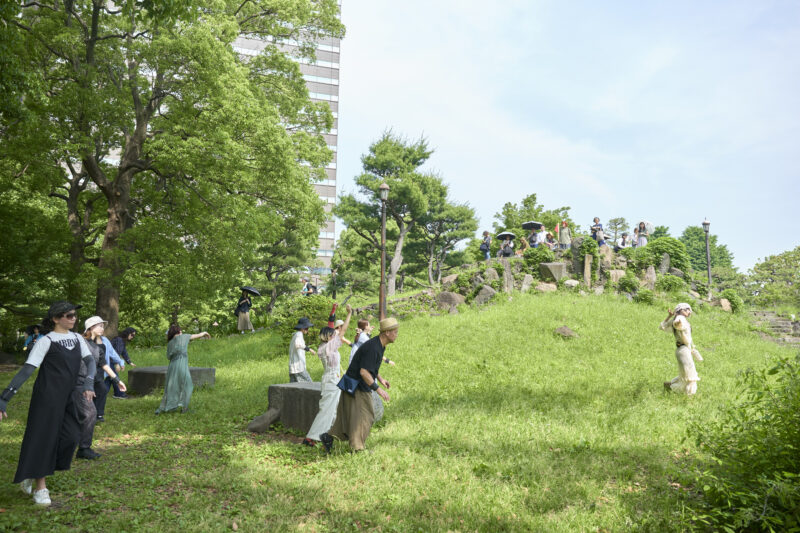
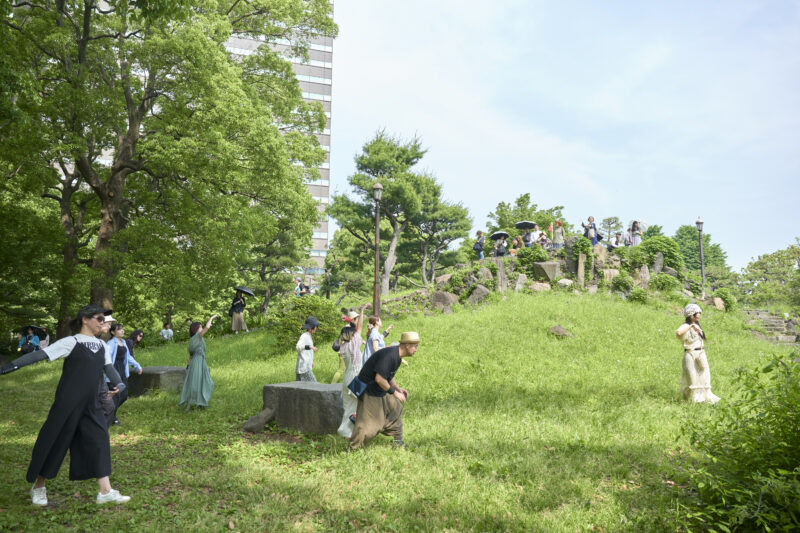
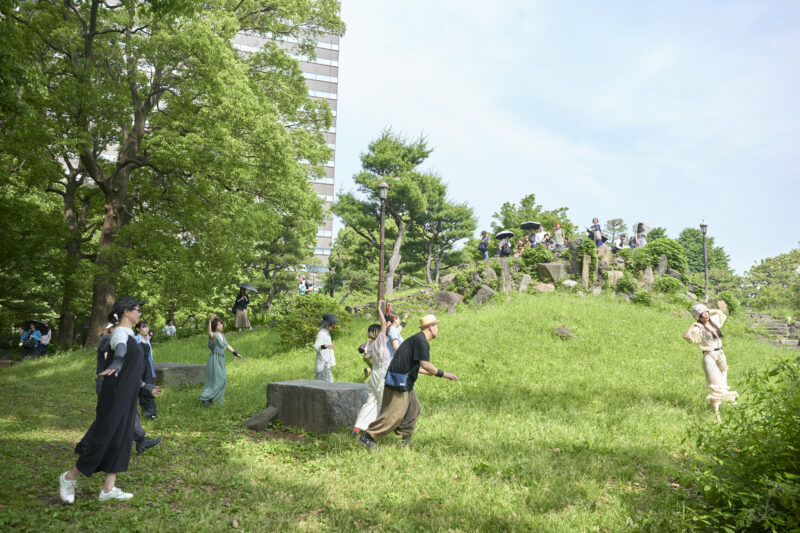
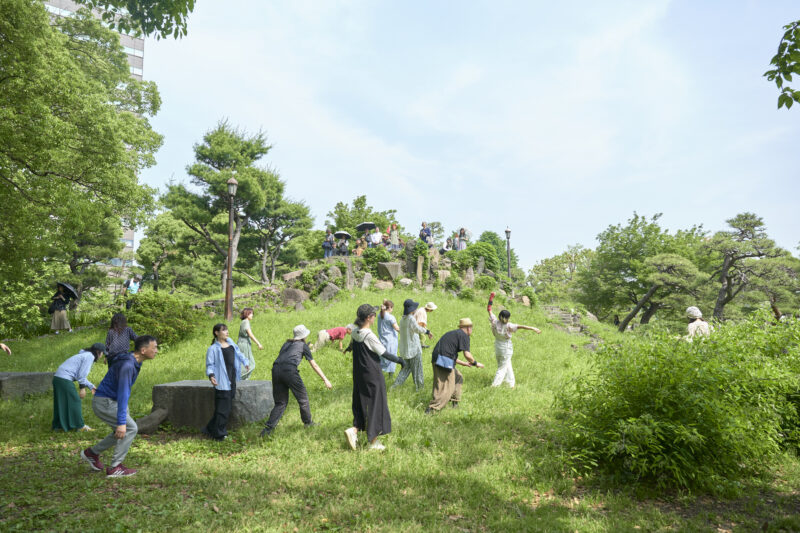
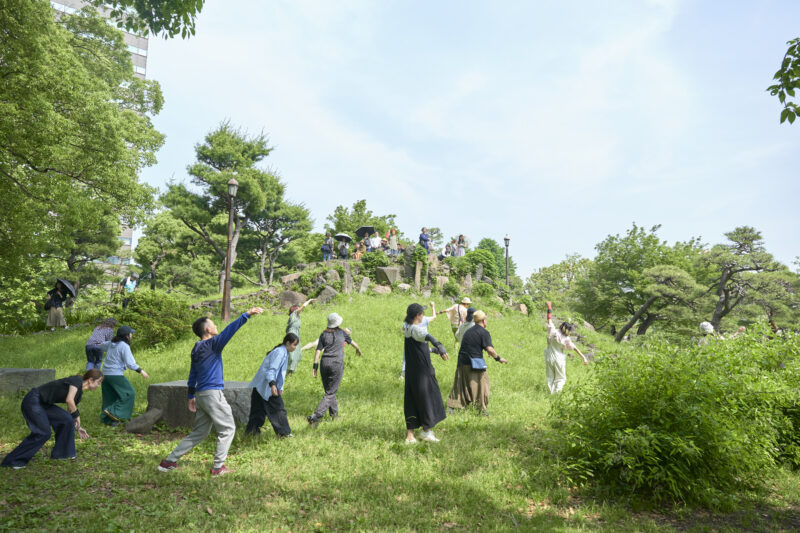
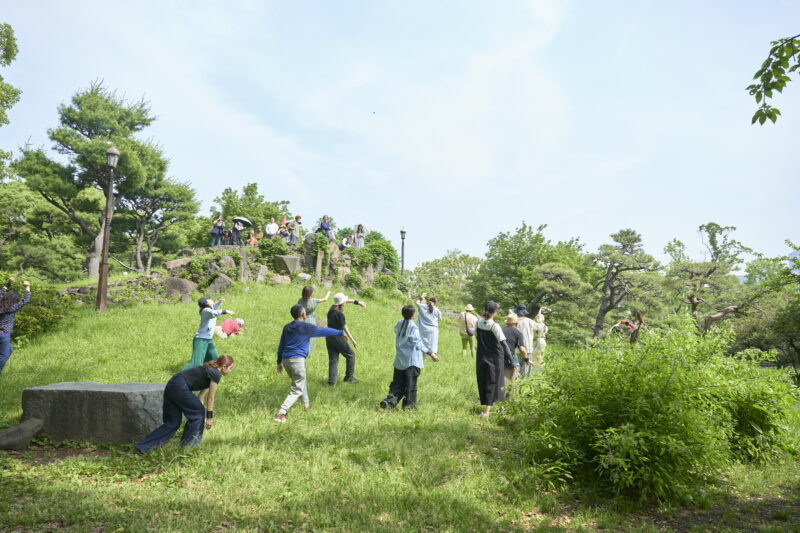
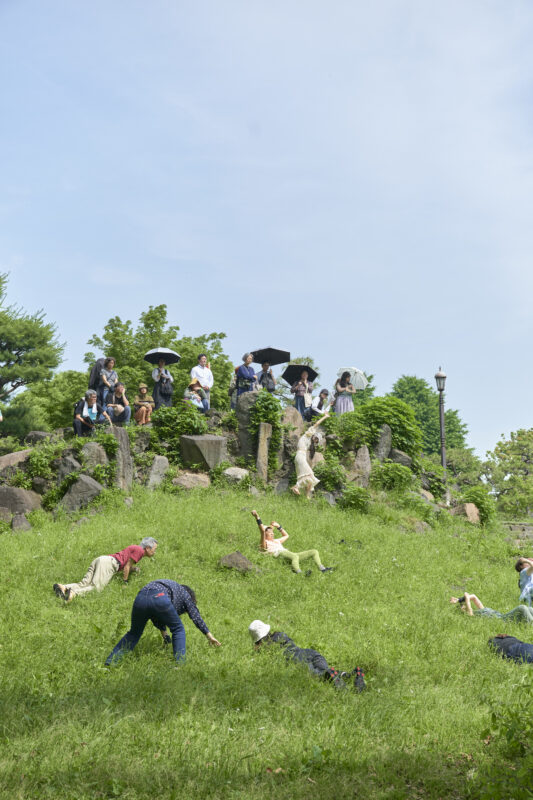
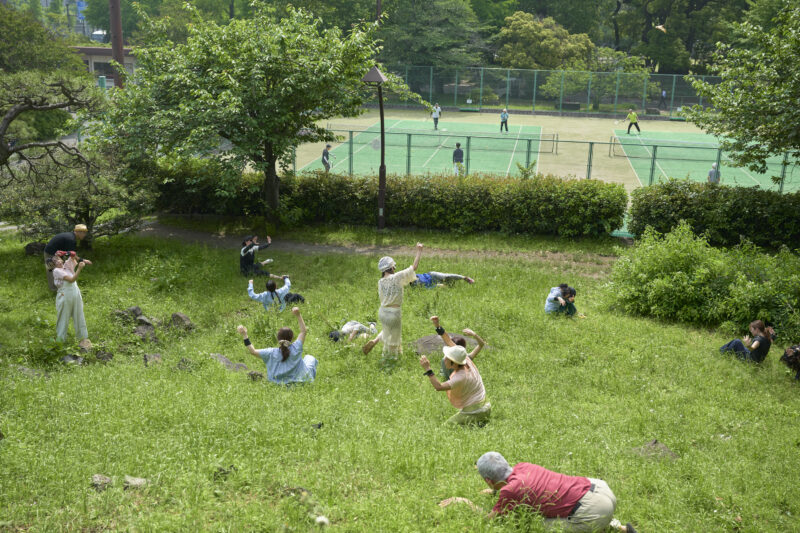
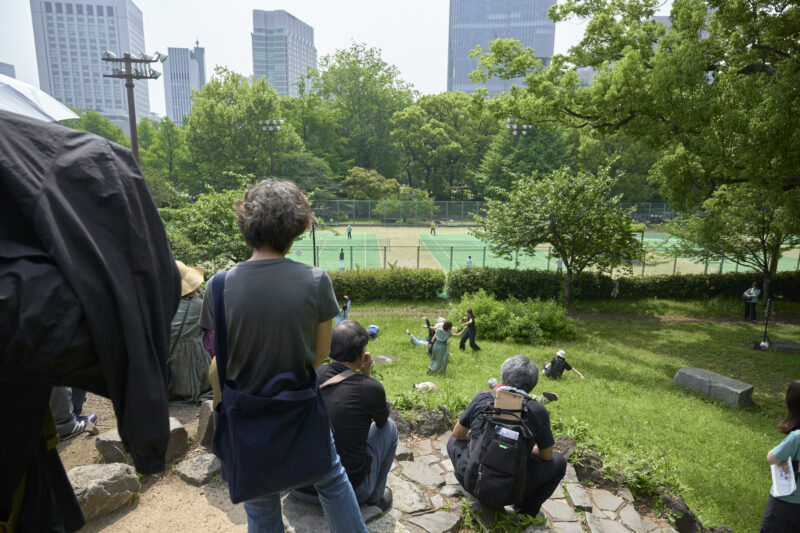
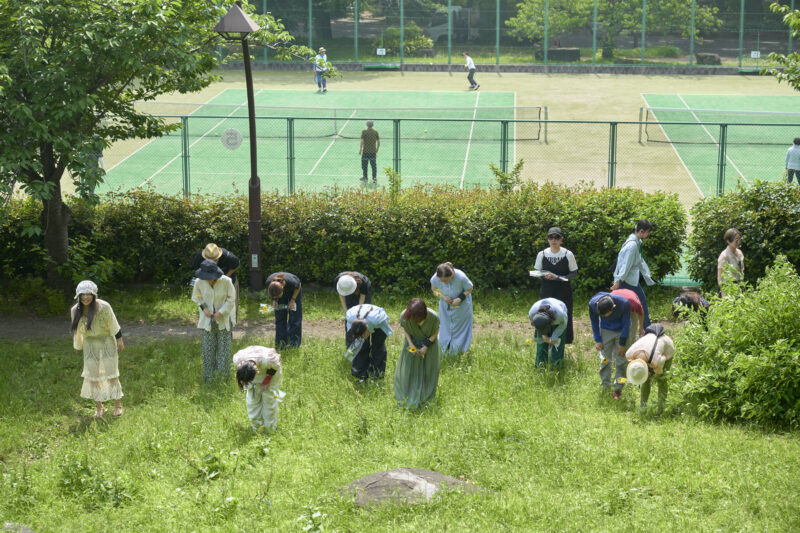
Participants selected through an open call were divided into performers and spectators. The performers became “small non-human creatures” and staged Ophelia’s drowning scene from Shakespeare’s Hamlet from the perspective of underwater organisms. The audience observed them discreetly, like passersby in a park.
We spoke with director Kumiko Ueda about this unique theatrical and choreographic experiment.
Text by Ryoko Takeuchi
— This project is the second edition of Breath Training Pool. How did the idea originally emerge?
The starting point was the COVID pandemic. In 2021, when I contracted COVID and was isolated in a hotel for two weeks, it initially felt like imprisonment. But gradually, I began to feel liberated from the pressure to “do something” or to “be productive.”
In the hotel, I never touched money. I could not choose where to go, what to eat, or what to buy. Being suddenly removed from the monetary economy — a system into which I had been born and whose existence I had rarely questioned — made me realize how constantly I had been driven by consumption. My sense of discomfort toward the world intensified.
After the isolation ended, I climbed Mount Rokko as a kind of rehabilitation. The sky, the clouds, the sea — nature appeared overwhelmingly vivid. At the same time, the familiar urban landscape felt strangely artificial. That experience strengthened my desire to see the world from a perspective other than the human one.
— What approaches did you take to explore “seeing the world from a non-human perspective”?
My first attempt was Biome (2022, Tokyo Tatemono Brillia Hall), in which I wrote about the consciousness of plants. However, because it was a staged reading, the plants had to speak in human language. I realized I had not truly escaped anthropocentrism.
Around that time, I read The Philosophy of Plant Life, which describes how all living beings form a vast circulation through respiration — the exchange of carbon dioxide — dissolving boundaries as they intermingle. This idea resonated deeply with what I had felt on Mount Rokko.
For the first edition of Breath Training Pool at Kinosaki International Arts Center, I conducted research with actors and dancers on how to “become non-human.” We focused on the concept of Umwelt — the idea that every organism inhabits its own specific perceptual world and acts according to it.
If that is the case, then to become a tree, one should not “imitate” a tree, but rather attempt to perceive the surroundings as a tree might. Participants altered their everyday sensory experience using face shields and modified sound environments, and experimented with changing their breathing patterns in order to imagine themselves as non-human entities.
— How did the Hibiya Park edition come about?
After the Kinosaki residency, I wondered whether a similar experiment could be conducted outdoors. When I learned about Hibiya Art Park 2025, Tomoya Takeda (Bench General Incorporated Association), director of the performing arts section, invited me to participate.
Hibiya Park is located in the heart of the city yet filled with greenery, constantly enveloped in urban noise. I felt it was the perfect site to imagine “non-human perception” through the body.
— How did the Hibiya Park version take shape?
In Kinosaki, the work was indoors, so participants received stimuli primarily through technology — video and sound design.
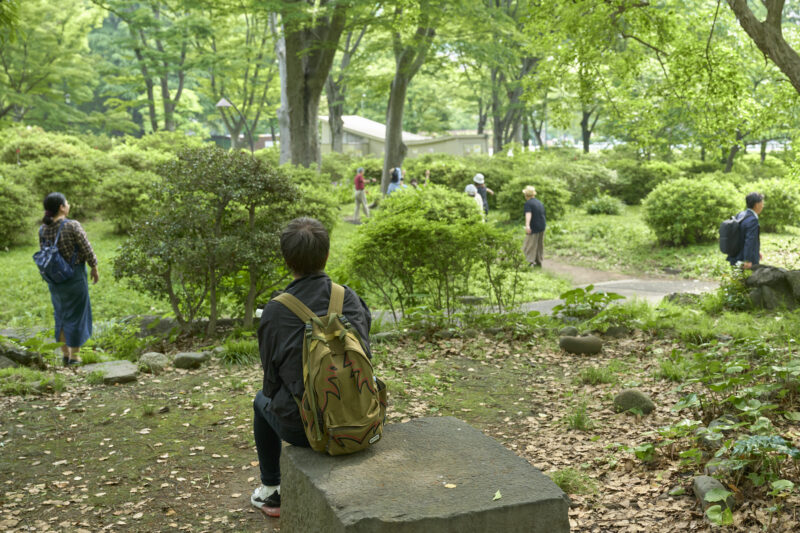
In Hibiya Park, however, there were real trees, uneven terrain, wind, and ambient sounds. As we walked through the park, we naturally discovered potential workshop sites. I strongly felt the power of the site — its affordances — meaning how the environment itself suggests possible actions, independent of human intention. It was as if the park itself guided the direction of the performance.
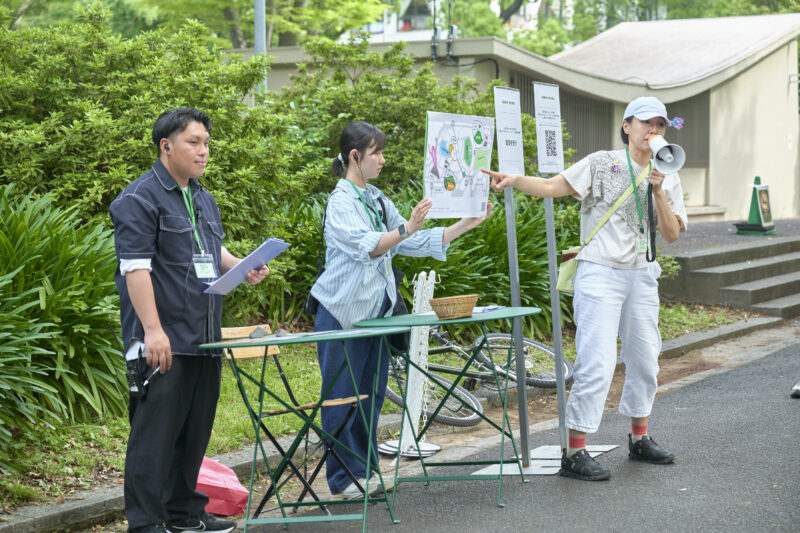
Together with dancer Mikiko Kawamura and sound artist miu, we constructed a tour route — determining how long to move through the park and in what manner.
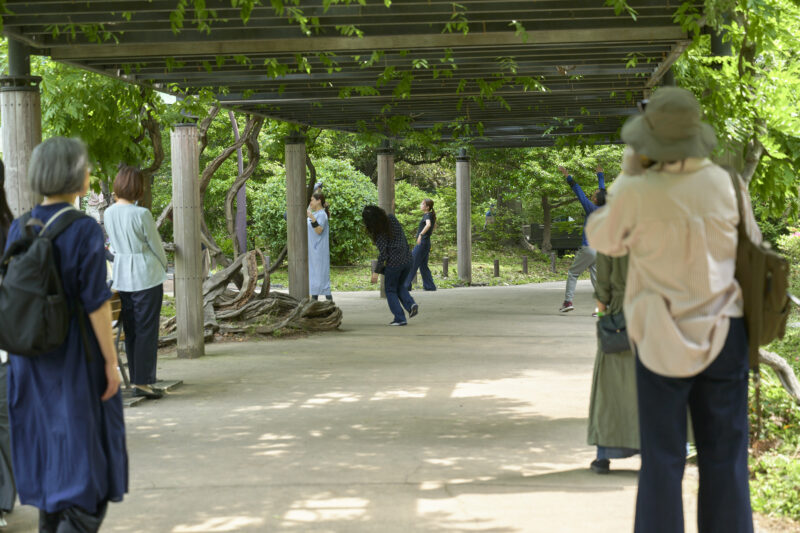
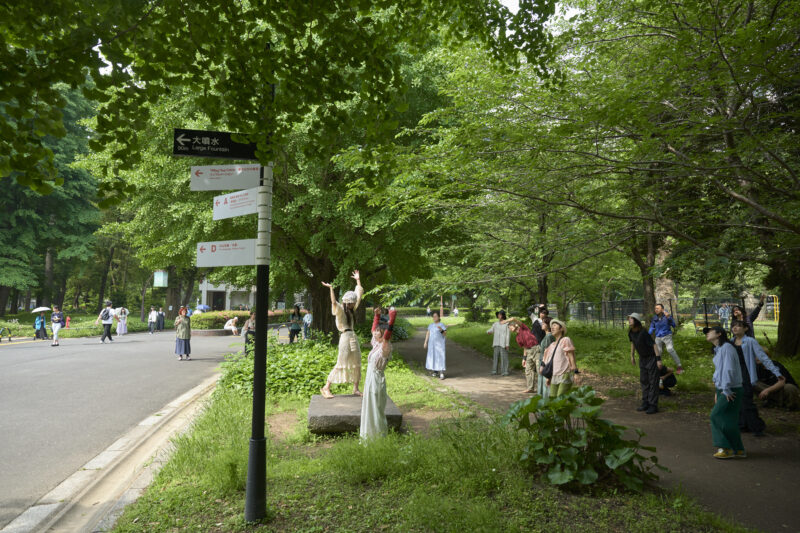
During the workshop portions, participants were invited to imagine relocating their breathing organs to their fingertips or backs, or consuming light as nourishment. We also playfully imagined the towering Hibiya Midtown building as a “giant Ophelia,” expanding the participants’ imagination in slightly absurd ways.
Ultimately, Mount Mikasa near the Imperial Palace became the audience seating area. Ophelia, performed by Kawamura, appeared among the performers spread across the slope.
The performers shared the imagination that their physical scale had shrunk. In doing so, we were able to merge the natural environment with a scene from classical theatre.
— The sound design was also unique.
Initially, we considered placing large speakers around the park to guide performers. But I disliked the idea of pre-conditioning the park as a “stage,” and broadcasting from a single dominant sound source felt authoritarian.
Instead, each performer carried a small radio. This allowed the audio instructions to remain suggestions rather than commands — something they could choose to follow or ignore. Even when separated from the group, participants could still hear the sound. The moving cluster of radios created a soft, shifting sonic field that subtly transformed the space.
For the audience, we also provided smartphone streaming. The stream combined a casual, almost trivial “morning radio” program — something that would not disturb a stroll — with descriptive narration of Ophelia’s drowning scene from Hamlet and contemporary music.
As a result, performers and spectators experienced the work differently.
— Did you anticipate this final form from the beginning?
No. I never begin with a fixed storyline or ending.
Even for the general participants, we started without knowing whether they would run or remain seated. When we entered the park, the form emerged naturally. The final structure arose from the site itself.
— Some performances began at 8 a.m.
There is an outdoor music hall nearby where sound checks begin in the afternoon, and the noon bell also rings. To avoid those interruptions, we chose the challenging 8 a.m. time slot.
Although it required early rising, many participants came. I was very grateful.
— After each performance, there was a mini-workshop. Why?
Some audience members may prefer to carry the experience home in silence; others may wish to share it verbally.
When participants applied to perform, they submitted short essays. They were all creative and fascinating. It made me realize that expression is not limited to professional artists. I wanted to create at least a small space for participants to articulate their perspectives and experiences. That is why we did not simply disperse immediately after the performance.
— Performers received a fee. That is unusual for workshops.
To become “non-human” in a public space involves vulnerability. Being seen carries risk and requires commitment.
While the honorarium of 2,000 yen might serve as motivation, it also represented a form of agreement acknowledging that risk.
— Finally, your reflections on the project?
It was striking that people who are not accustomed to being watched transformed completely once placed in front of an audience. Perhaps the responsibility of being seen generates a sense of mission. Their performances during the actual presentation were entirely different from rehearsals.
People often say that the stage allows actors to grow the most. It turned out to be true.
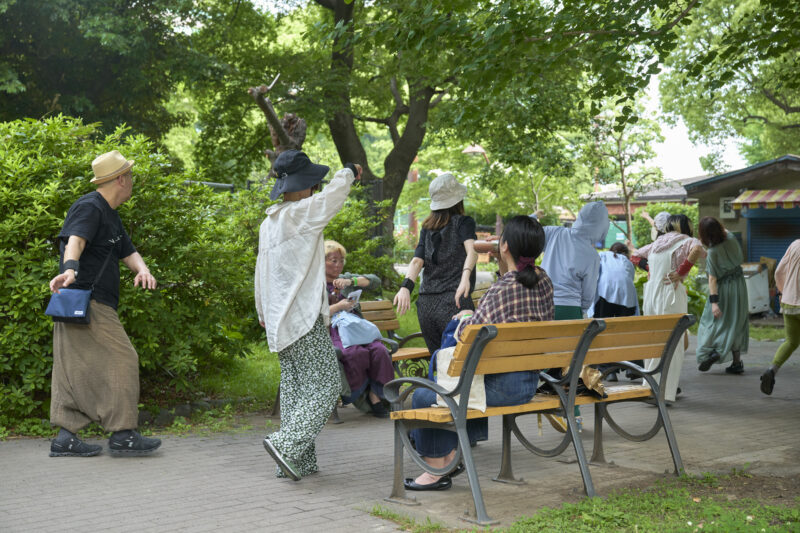
For the audience as well, unlike in a theatre that demands total concentration and silence, this open format allowed freedom. Children could wander off and return; spectators could even join and become “bacteria.” Passersby and foreign tourists spontaneously began dancing.
On the final day, the audience, performers, and park space seemed to merge into a single enormous organism. It was a magnificent and moving sight.
The post-performance surveys revealed that each participant had a unique experience. I felt the breadth of what this experiment had opened.
In the future, I would like to recreate this work in various natural environments, collaborating with local residents in different regions. I welcome invitations.
Hibiya Park, being a metropolitan public park, came with many regulations and constraints. The production team worked hard, and the Tokyo Metropolitan Park Association gradually came to appreciate the project and supported us enthusiastically.
Many participants said, “I had no idea Hibiya Park could be such an interesting place.” That, too, was meaningful.
Director / Concept: Kumiko Ueda
Sound: miu
Movement Navigation: Mikiko Kawamura
Technical Direction: Yutaka Endo (LUFTZUG)
Sound Engineering / Operation:
Raku Nakahara (KARABINER inc.),
Hayato Arai (Ooshiro Sound Co., Ltd.)
Key Visual: Aiko Koike
Coordination: bench
Production: Hitomi Sato (bench)
With the Support of:
Kinosaki International Arts Center (Toyooka City),
The Saison Foundation
Outside Eye: Akinobu Osaki
©︎Ryota Haraguchi