Breath Training Pool — Report

In May 2025, at Hibiya Art Park 2025 in Tokyo’s Hibiya Park, the second edition of the participatory performance Breath Training Pool was presented under the title Imperial Moat Edition.
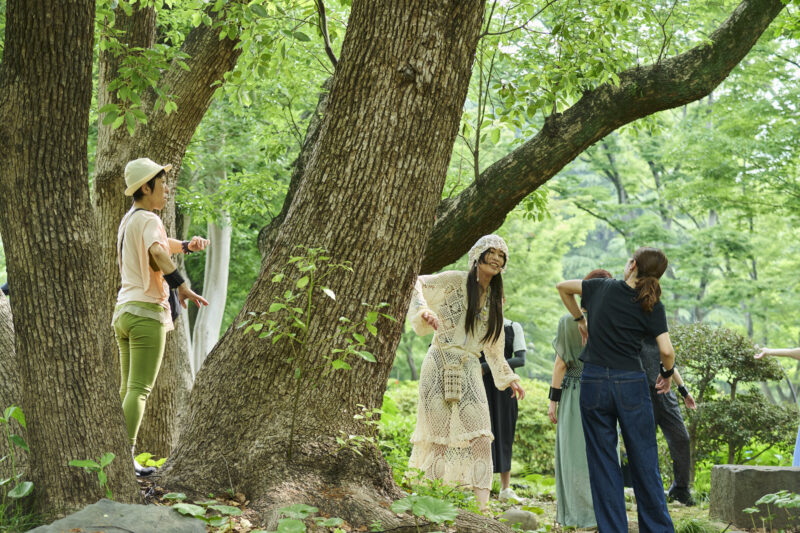
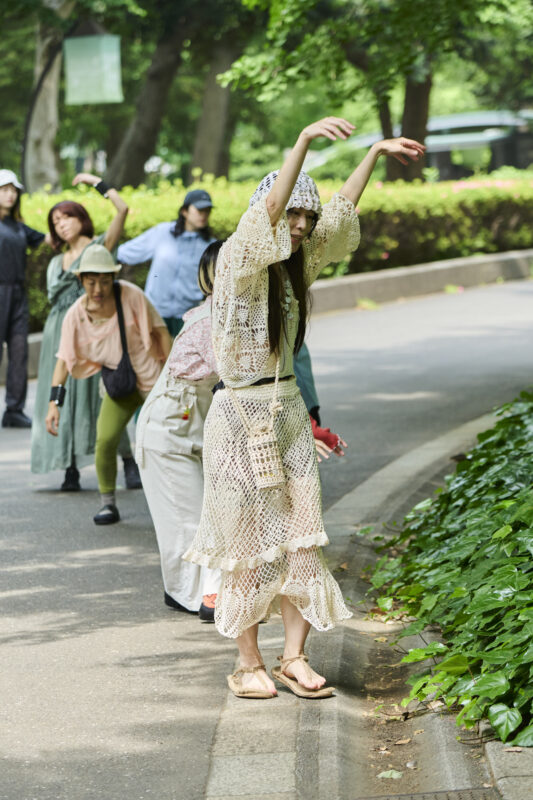
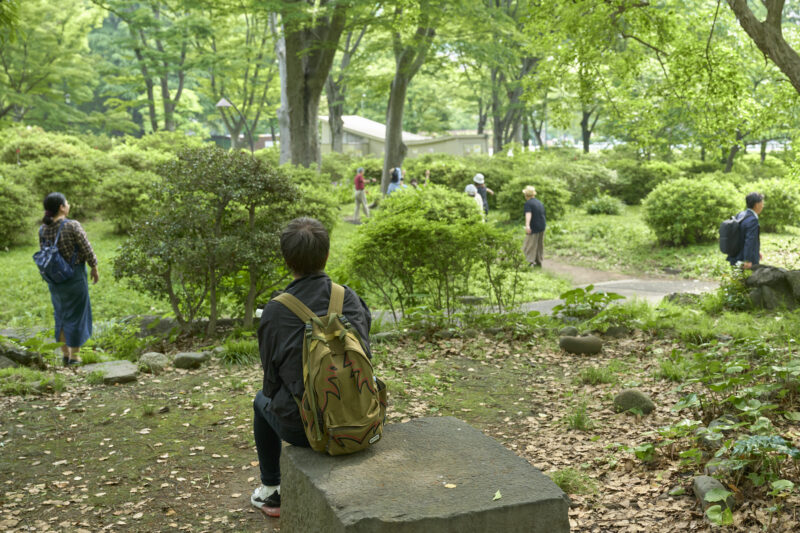
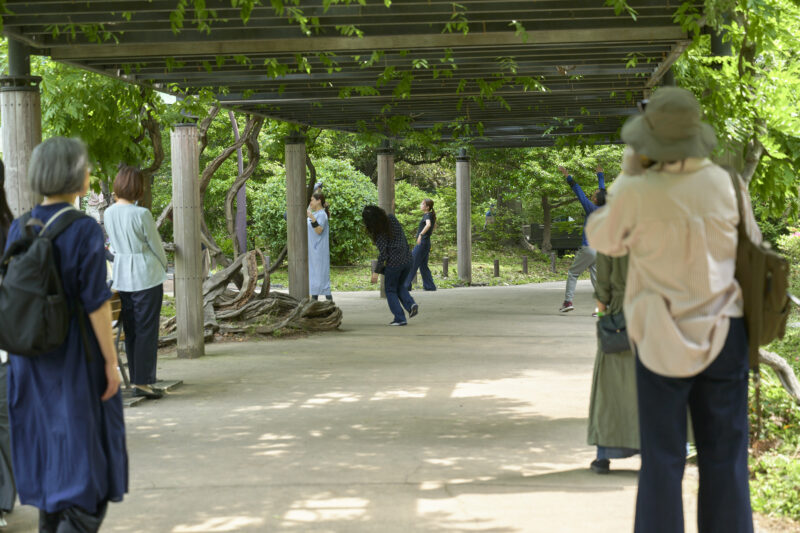
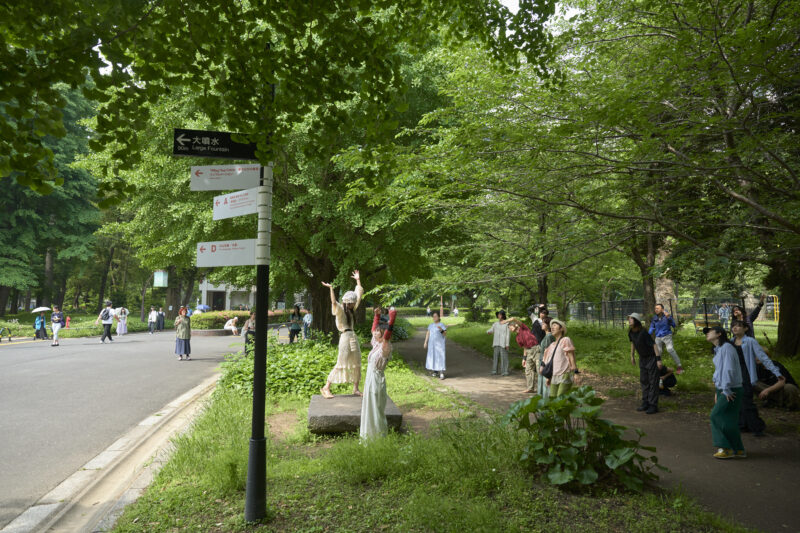
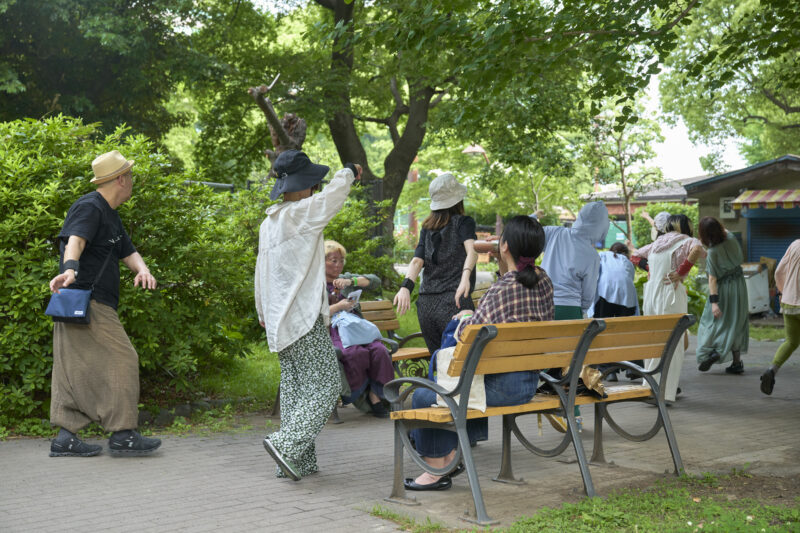
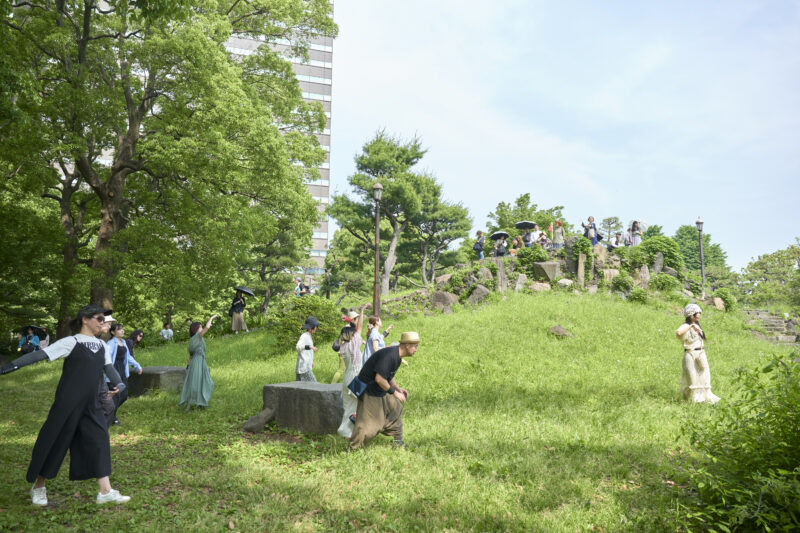
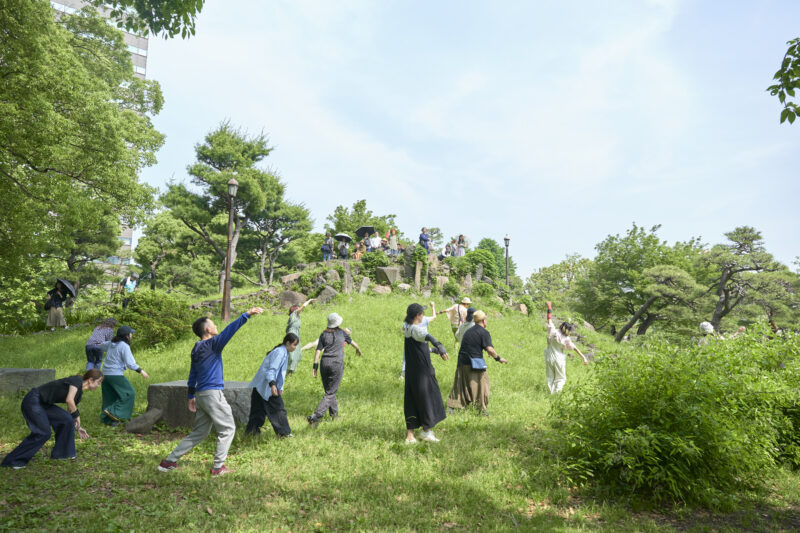
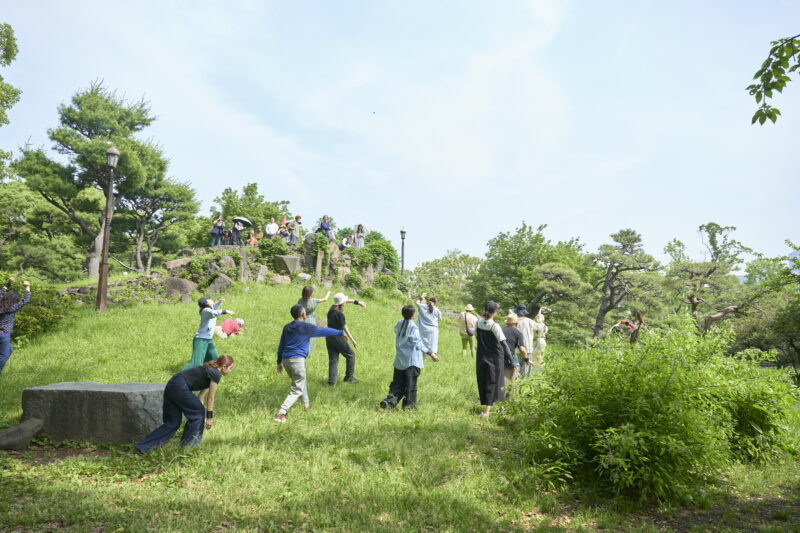
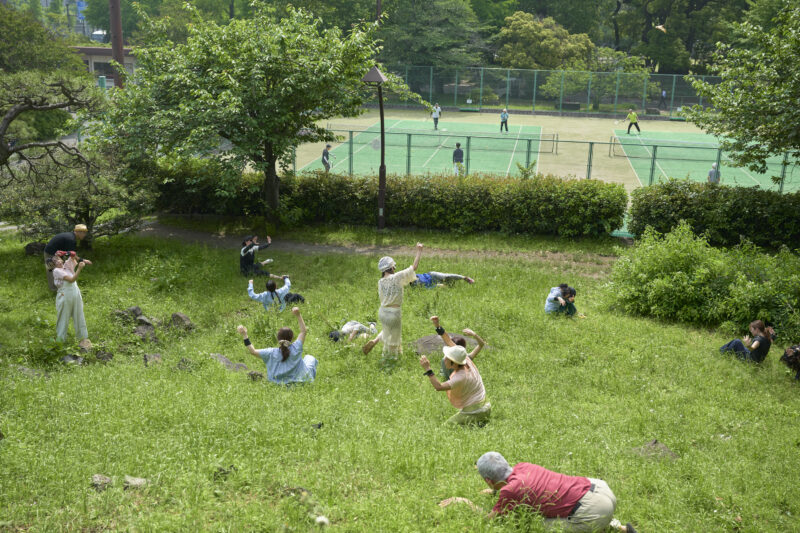
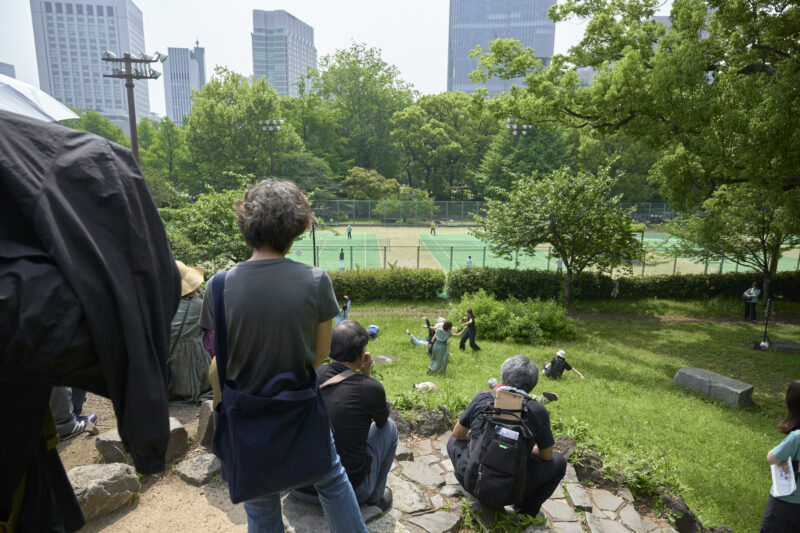
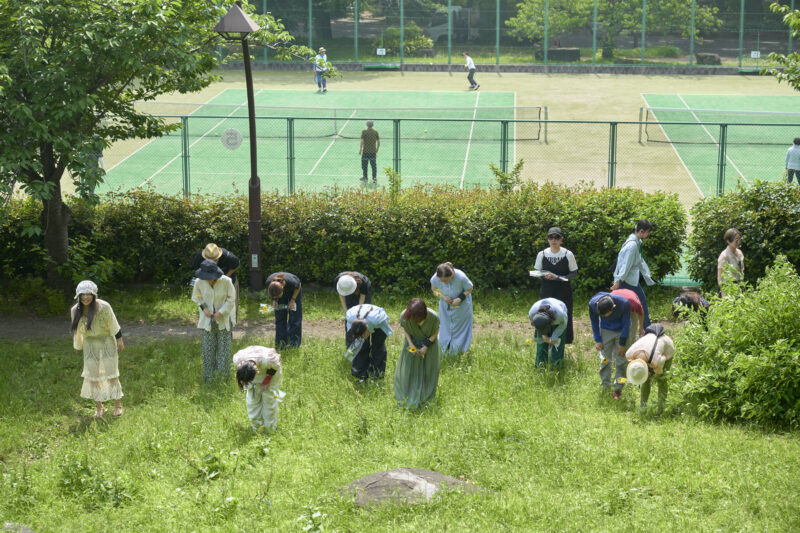
Participants selected through an open call were divided into performers and spectators. The performers became “small non-human creatures” and staged Ophelia’s drowning scene from Shakespeare’s Hamlet from the perspective of underwater organisms. The audience observed them discreetly, like passersby in a park.
We spoke with director Kumiko Ueda about this unique theatrical and choreographic experiment.
Text by Ryoko Takeuchi
Interview with Kumiko Ueda
— This project is the second iteration of “Breath Training Pool.” What was the initial impetus behind it?
The starting point was the COVID-19 pandemic.
In 2021, after contracting COVID and being isolated in a hotel for two weeks, I began to develop an interest in how one might slip out of one’s habitual modes of perception and understanding of the world.
At first, being unable to go anywhere or do anything felt like a kind of prison. Gradually, however, I realized that what was oppressing me was not the restriction itself, but an internalized ethic—the sense that one must do something productive every day, and that choosing what to do is one’s own responsibility.
Since it was impossible to fulfill that expectation, I gave up and remained still. Strangely, something like a monastic calm began to emerge.
For the first time since childhood, I had no contact with money. I could not choose what to eat, where to go, or what to consume. The “productivity” demanded by society simply could not exist in that situation.
Productivity is not only about producing work; it is also felt through forms of “acquisition”—gaining pleasurable experiences, buying something, or even simply spending money. Even on a day of complete rest, going to the supermarket and buying something as trivial as toilet paper can make the mind feel as if something has been accomplished. In the hotel, even that was impossible.
Yet, by stepping away from a mode of life into which I had been born—and whose existence I had therefore never consciously perceived—I began to experience an unexpected sense of fulfillment.
I may have momentarily slipped outside the capitalist ethic that had been internalized within me, and found myself satisfied simply with being alive.
After the isolation ended, I returned to the city and climbed Mount Rokko as a kind of rehabilitation after two weeks of hardly walking. As I dragged my heavy legs up the mountain, the presence of nature—the sky, the clouds, the sea—appeared with an intensity I had never experienced before.
At the same time, the familiar landscape of the city—those human-made structures—felt like strange, foreign objects within nature. For a moment, I wondered whether I had come closer to seeing the world through the eyes of the deer or wild boars of Mount Rokko.
It occurred to me then that stepping outside the modern human sensibility—so ordinary to us that we can hardly perceive it, yet in fact highly specific and limited—might function as a kind of preparatory exercise. It might allow us to think more flexibly about the future of a world that increasingly feels as though it has reached an impasse.
From there, I began to imagine a kind of perceptual training: a work that would allow spectators to experience the world as it might be perceived by non-human beings, like the deer of Mount Rokko.
— What kinds of approaches did you take in order to “see the world from a non-human perspective”?
In my earlier work Biome (2022, Tokyo Tatemono Brillia Hall), I attempted to write the consciousness of plants. However, because it took the form of a reading performance, the plants ended up speaking human language, and I feel that I was unable to escape anthropocentrism.
Around that time, I read a book titled The Philosophy of Plant Life, which described how all living beings form a vast circulation through the exchange of carbon dioxide via “breathing,” blending into one another without clear boundaries. This resonated strongly with my experience on Mount Rokko.
In the first iteration of Breath Training Pool at Kinosaki International Arts Center, I worked with actors and dancers to explore how one might become something other than human through breathing.
Rather than showing professional performers acting as plants or microorganisms, as in Biome, I wanted the audience to become microorganisms and observe human drama performed by professional actors.
This led me to imagine the well-known tragic scene of Ophelia’s drowning being experienced from underwater—by spectators who had become bacteria or aquatic plants.
But how can non-professional participants become non-human beings?
Here, I turned to the concept of Umwelt: the idea that each living being inhabits its own specific perceptual world and acts accordingly.
From this perspective, becoming a tree does not mean imitating a tree, but sensing the surroundings as a tree might. Under the guidance of Mikiko Kawamura, participants altered their everyday perception and breathing, becoming bodies that were no longer their usual selves. One cannot literally become a tree, but deviating from one’s habitual human perception became the operative definition of performing the non-human.
In this iteration, participants who experienced Ophelia’s death as other life forms were designated as “performers,” while another group of “spectators” observed them from the outside. This created a nested structure: people watching those who were themselves watching Ophelia’s death as non-human beings.
— What were your impressions after the performances?
Each performance differed significantly, as the participants changed each time, and the behavior of passersby in the park also varied depending on the time of day.
On the final day, however, the spectators, performers, and the park itself seemed to merge into a single, vast living organism. It was a striking and deeply moving sight.
Another observation, though perhaps a curious one: even participants who are not used to being seen by others seemed to develop a sense of necessity once placed in front of an audience. Their performances became far more active and engaged than in rehearsal. It made me realize that the idea that “the stage itself allows actors to grow” might actually be true.
As for the spectators, unlike in a theater where total concentration and silence are expected, the format allowed for a more open experience. People could step away, children could play and return, and some even joined in as “bacteria.” At times, passing foreign tourists spontaneously joined and began to dance.
Some participants who initially disliked insects reported that, through closely observing the performance and imagining non-human life, they began to feel a sense of familiarity with them—rolling through the grass with their whole bodies.
— How did the second iteration in Hibiya Park come about?
The residency in Kinosaki took place indoors, but based on the results, I felt the work should be developed in a natural environment. Around that time, I was invited by Tomoya Takeda, director of the performing arts program at Hibiya Art Park 2025.
Hibiya Park, located in the center of Tokyo yet filled with greenery and enveloped in urban noise, seemed like an ideal place to imagine the human world from a non-human perspective.
— How did you develop the Hibiya Park version?
Together with choreographer and performer Mikiko Kawamura and sound artist miu, we walked through the park and constructed the piece. The park itself—its trees, terrain, wind, and sound—offered cues. The structure of the work emerged from the site.
Workshops included imagining breathing through fingertips or the back, or absorbing light as nourishment. We also playfully imagined the high-rise buildings of Tokyo Midtown Hibiya as a “giant Ophelia,” expanding the participants’ imagination.
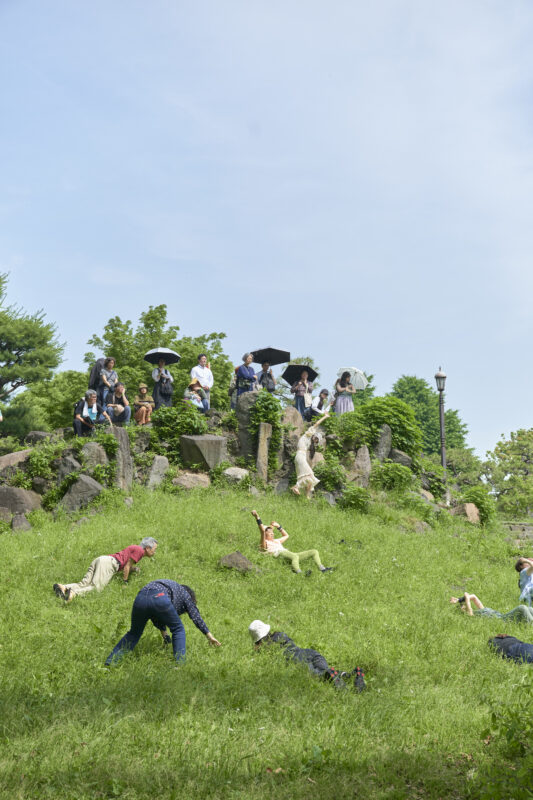
In the end, Mikasa-yama became the audience seating, and Ophelia, performed by Kawamura, appeared. The participants rolled down the slopes, sharing the sensation that their scale had become smaller, and creating a fusion between natural space and a scene from classical theater.
— The sound design was also distinctive.
Initially, we considered placing large speakers throughout the park, but rejected the idea because it would impose a fixed theatrical framework and felt overly authoritative.
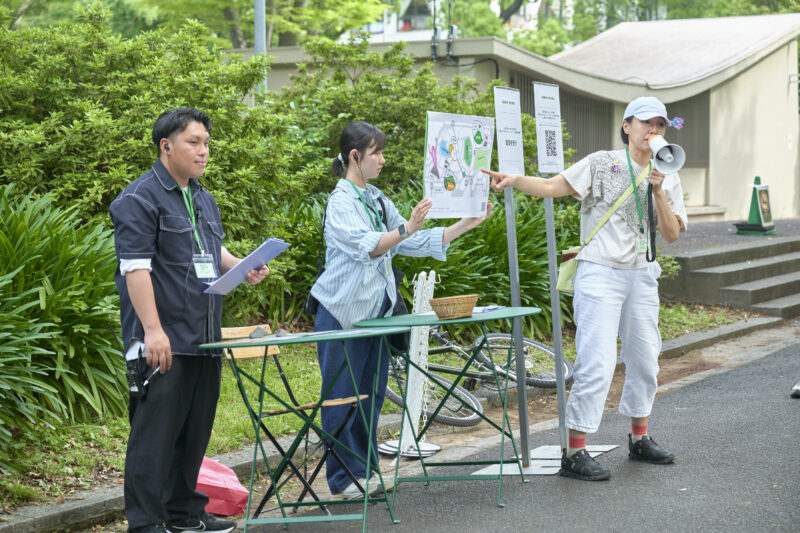
Instead, each performer carried a small radio. This allowed the audio instructions to function as suggestions rather than commands. Even when separated from the group, participants could still hear the sound, and the moving cluster of bodies generated a shifting sonic field.
For spectators, we also provided audio via smartphone streaming. This included a casual, almost trivial radio-like program, combined with descriptions of Ophelia’s drowning scene and contemporary music.
As a result, the experiences of performers and spectators diverged in interesting ways.
— Did you anticipate this form in advance?
No. I did not begin with a fixed structure or conclusion.
Even what participants would do—whether they would run or remain still—was unknown at first. The form emerged through being in the park, and eventually became what it is.
— Some performances began at 8 a.m.
There is an outdoor concert hall nearby, and sound checks and bells would begin later in the day, so we chose an early hour to preserve quietness.
It was a demanding time, but many participants came early, which I appreciated.
— Participants were paid. That is unusual for workshops.
Becoming a non-human being in a public space involves exposing oneself in a vulnerable way. Being seen carries risks and requires a certain commitment.
While the payment of 2000 yen also served as motivation, it was equally intended as a way of acknowledging and forming consent around those risks.
— There were also post-performance workshops. Why?
Some people prefer to carry their experience without verbalizing it, while others want to share it.
Applicants were asked to write a short essay, and their responses were remarkably creative. It made me realize that expression is not limited to professional artists. People have always expressed themselves—through folk songs, dances, rituals.
I wanted to create a space to share that inherent human capacity.
— Any final thoughts?
I feel that the initial aim—to step outside the limited framework of modern human perception and to attempt a preparatory exercise for thinking about the future more flexibly—has been realized.
In the future, I would like to recreate this work in different natural environments and with different communities.
The post-project surveys showed that participants had deeply personal, internal experiences, which was very meaningful to me.
I would like to include, as one example, a report written by Takeuchi on the website.
Director / Concept: Kumiko Ueda
Sound: miu
Movement Navigation: Mikiko Kawamura
Technical Direction: Yutaka Endo (LUFTZUG)
Sound Engineering / Operation:
Raku Nakahara (KARABINER inc.),
Hayato Arai (Ooshiro Sound Co., Ltd.)
Key Visual: Aiko Koike
Coordination: bench
Production: Hitomi Sato (bench)
With the Support of:
Kinosaki International Arts Center (Toyooka City),
The Saison Foundation
Outside Eye: Akinobu Osaki
©︎Ryota Haraguchi